History of the Site
Introduction
Homer, the great singer of tales, describes Mycenae as well built (euktimene), with wide streets (euryagyia), and rich-in-gold (polychrysos) in his famous epic poems Iliad (II.569, IV.52, VII.180) and Odyssey (III.305). Such epithets were used repeatedly, interchangeably and rather conventionally for various cities in the formulaic language of Greek oral epic poetry – but not so for Mycenae. These three Homeric words epitomize vividly and effectively the complex archaeological picture of Mycenae that has emerged in the last two centuries. Systematic excavations and surveys of the site have revealed an imposing citadel fortified with massive cyclopean walls – a marvel of engineering – which comprised a magnificent palace, shrines and temples, workshops and storerooms, houses, and royal graves; outside the citadel walls were excavated parts of a large and densely populated town, extensive cemeteries with richly furnished royal shaft graves and monumental tholos tombs, an impressive water supply system of clay pipes, channels, underground cisterns, and dams; finally, an extensive road network was traced connecting the citadel with its surrounding region and with select ports that gave access to trade routes all over the Mediterranean. Mycenae, a world heritage site, was the leader of a closely-knit network of palatial states that shared a homogeneous culture – the fabled Mycenaean civilization.
Geomorphology, Location, and Topography of Mycenae
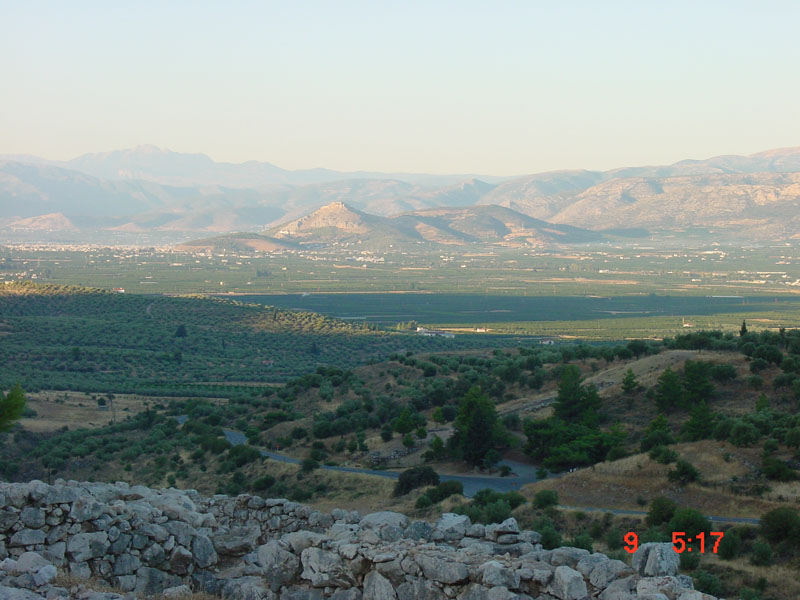
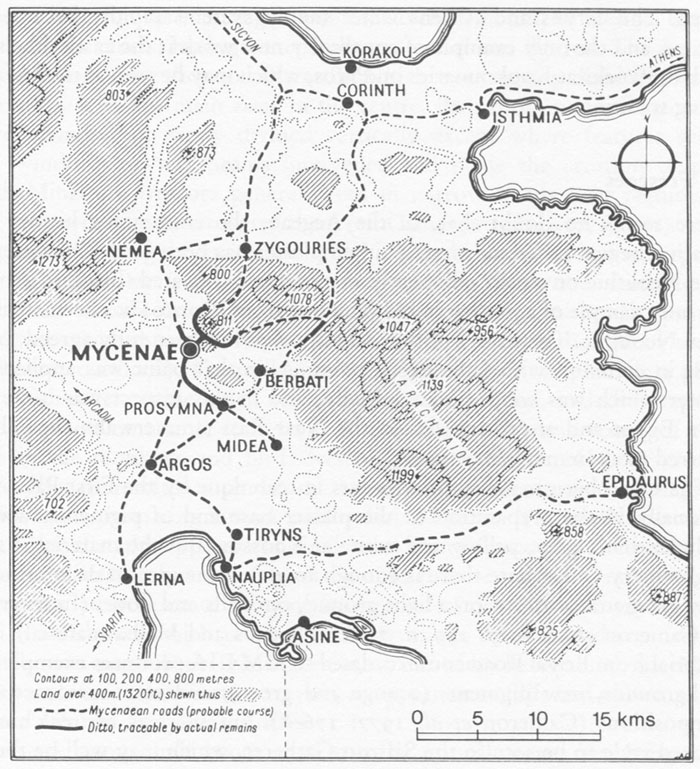
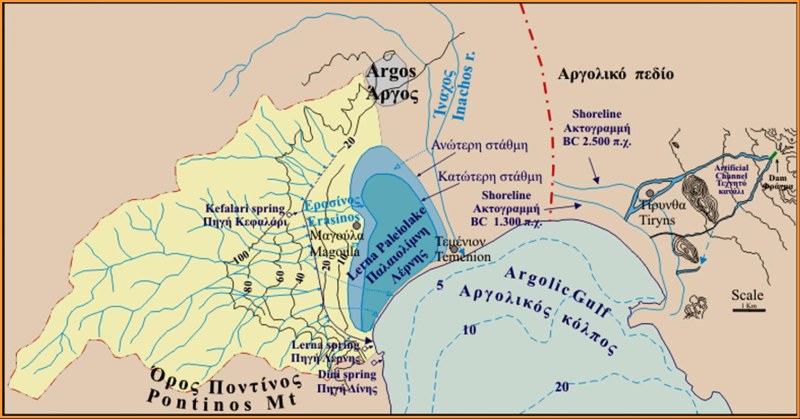
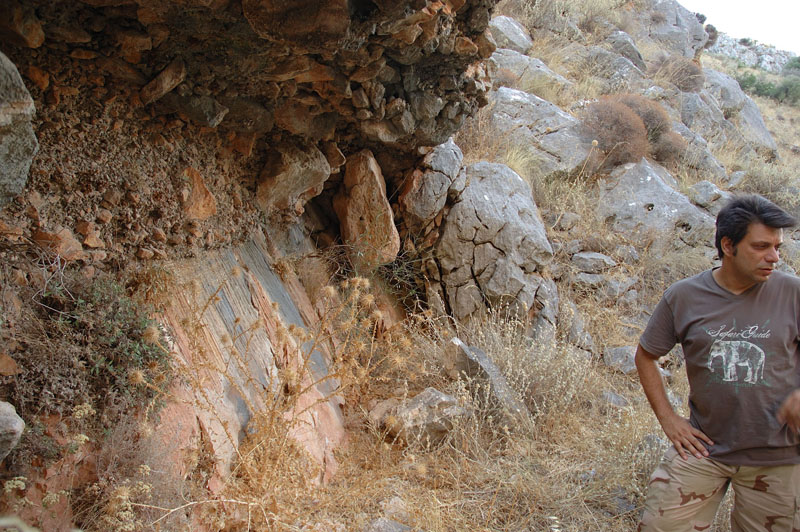
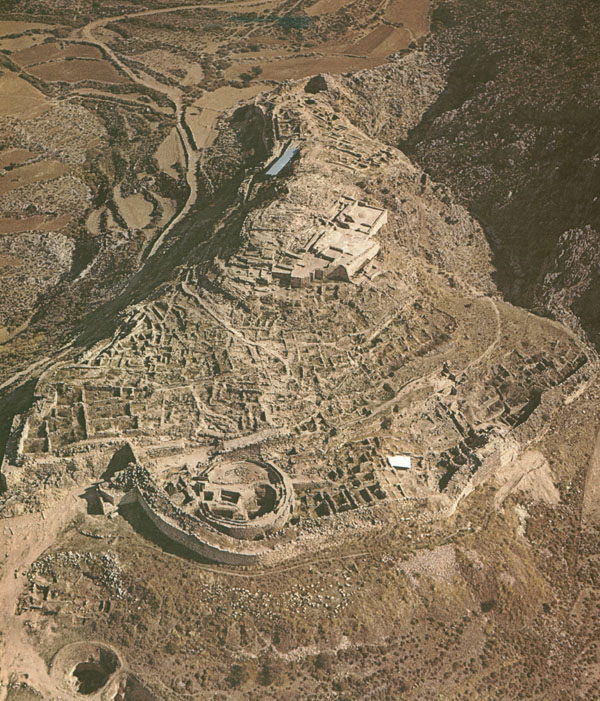
The citadel of Mycenae, which in its final form comprised an area of 30,000sqm surrounded by a 900m-long circuit wall, was built on a low rocky hill rising 278m above sea level and approximately 40-45m above the surrounding plain. The hill of Mycenae is nestled between two mountains, Profitis Elias to the north and Zara to the south, from which it is separated by two ravines formed by winter torrents, Kokoretsa and Chavos, respectively; it is, therefore, a natural strong-point, protected by deep gorges and steep rocky sides all around, except its western slope which is the only accessible side, and is constantly supplied with fresh water by the Perseia spring which lies 360m to the east of the citadel and approximately 13m higher than its summit. The hill of Mycenae and the adjacent mountains belong to the western part of the Arachnaion mountain range that divides the Argolid from Corinthia, and rise in the northeastern corner of the Argive plain at the mouth of the only passage connecting the two regions (Tretos gorge or modern Dervenakia) and in the crossroads of the eastward routes to the Hermionid and the Saronic Gulf. The hill of Mycenae, therefore, combines a strong geopolitical location which controls access points to and from the Argolid, and a commanding view of the Argive plain to the south below. The triangular plain of the Argolid, surrounded and isolated by mountain ranges, stretches approximately 14km along the coast and 21km inland. The coastline of the Argolid Gulf shifted repeatedly in prehistoric times as a result of post-glacial melting and alluvium deposits; in the 2nd millennium BC the sea was much closer to the site of Tiryns than the present-day shore line, which must have been the main port of the Argive plain. Finally, a significant fault measuring some 2-4.5km in length, 1.5m in width and a maximum vertical displacement of 3m has been located to the east/northeast of the citadel of Mycenae, showing traces of multiple reactivations in the past, which caused intense local seismic activity in the 13th century BC and considerable damage at Mycenae, Tiryns and possibly Midea.
A Brief History of Mycenae and the Mycenaean World
The first Greeks descended through the Balkans into mainland Greece in ca. 2300/2200 BC (beginning of the Early Helladic III). They settled down mainly in the fertile inland, formed villages and eventually small towns, organized egalitarian societies and developed a distinct regional culture (Middle Helladic) based on agricultural economy and limited trade contacts with the Cyclades and eventually Crete. Rising to power was a long process through trade, diplomatic contacts, and constant warfare abroad and at home during the formative Early Mycenaean period (Late Helladic I-IIA/B, ca. 1650-1420/1410 BC). The Mycenaeans proved to be meticulous students: through increasing contacts with Minoan Crete, their trade horizons gradually expanded from the Balkans and Northern Europe to Egypt, the Levant, Cyprus, and Asia Minor. This gradual expansion is documented in the multicultural amalgam of stylistic, iconographic, technical elements and materials of the exquisite finds in the royal Shaft Graves at Mycenae (Minoan, Egyptian, European/Balkan, Hittite, and Helladic influences), the extensive corpus of foreign imports in Greece (orientalia and aegyptiaca), and the increasing Mycenaean exports abroad. Contemporary iconographical evidence (e.g. flotilla fresco from Akrotiri at Thera, silver Siege Rhyton from Grave Circle A at Mycenae) illustrate some of the early military achievements of the rising new power abroad: raiding jointly with the Minoan fleet foreign exotic lands (Egypt?), sieging and sacking foreign towns. The Mycenaeans were recorded as “Ahhiya” or “Ahhiyawa” (~Homeric Achai(w)oi/Achaeans) in Hittite diplomatic documents already by 1420/1400 BC (since the reign of Tudhaliya II) and as “Danaja” or “Tanaja” (~ Homeric Danaoi) in Egyptian tribute lists like those of Thutmose III (ca. 1450 BC) and Amenhotep III (Karnak, ca. 1380 BC), or on a statue-base from Kom-el-Hetan (ca. 1380 BC), where “Mukanu” or mki[n] (~Mycenae) was listed first among mainland sites. In the following decades, the “Danaja” references in Egyptian sources gradually replaced the earlier “Keftiu” accounts and depictions of Minoan embassies of the 15th century BC, echoing contemporary archaeological evidence for drastic Mycenaean expansion and simultaneous reduction of Minoan presence abroad. This reversal of the political and military situation in the Aegean in the 14th century BC was triggered by the gradual infiltration and, arguably, military presence of the Mycenaeans on Crete in 1420/1410-1370 BC (Late Helladic IIIA1), in the wake of a devastating earthquake which had leveled the Minoan palaces and left the Minoan world in disarray. The Mycenaean occupation of Crete marked for the Minoans the beginning of the end and for the Mycenaeans the end of the beginning.
The Mycenaean world and particularly Mycenae flourished in the following two centuries (ca. 1420/1410-1200/1175 BC), a period known as Palatial Mycenaean or Late Helladic IIIA/B. The Minoan palaces served as modus operandi for the sociopolitical and economic organization of the rising Mycenaean states. This period is marked by regional centralization of power, state formation, and advanced socio-economic organization, geared towards efficient surplus local production and overseas trade, both coordinated and regulated by the palace administration and sustained by palatial bureaucracy (Linear B). At home, the Mycenaean palaces were fortified into citadels, large-scale public works were carried out, and production was systematized; at Mycenae, the cyclopean walls were constructed (1350 BC) and later expanded with the addition of the Lion Gate and postern gate (1250 BC), water supply was secured by means of an underground cistern and dams (1200 BC), a new palatial complex was built to replace an earlier palace (1300/1250 BC), the outer town expanded, roads and bridges were built to serve the region of Mycenae. Abroad, the Mycenaeans assumed control over the Minoan colonies and trade outposts in the Aegean and Eastern Mediterranean, and further expanded to the east and west, thus firmly establishing their own trade network and successfully succeeding the Minoans in the overseas trade (Mycenaean thalassocracy). A vital sector of the centralized palatial economy and sociopolitical structure, overseas trade required not only a tight network of island and coastal outposts, but also highly effective diplomacy. Diplomatic contacts involved exchange of royal letters and gifts, ambassadors, official royal visits, treaties and bilateral agreements. Certain Mycenaean palaces like Mycenae, Thebes, and Pylos maintained a protagonistic role in overseas trade of luxury/prestige goods and diplomatic contacts at the highest level. The organized trade of luxury/prestige goods which required a well-coordinated control mechanism for acquiring raw materials and producing artifacts or other products to be marketed in exchange, afforded luxury to the elite, while the king’s special access to external prestige goods reinforced royal image and authority. The exquisite artifacts found in tombs in the area of Mycenae, Pylos, and Thebes, as well as the great variety of precious materials recorded in palatial inventory lists and yielded in the archaeological contexts of palatial workshops further document privileged connections and constant contact with Egypt, Anatolia, and the Near East, closely following the successful Minoan archetype.
In the course of the 12th century BC rapid, dramatic, and combined changes in several of socio-economic, political, and environmental variables affected a fragile balance and triggered a chain reaction whose accumulating effect was progressively magnified and multiplied, resulting inevitably in a catastrophic systems collapse which caused the decline and fall of the Mycenaean world. The latter half of the 13th century BC was marked by intense and frequent seismic activity in certain regions of mainland Greece (two major destruction horizons were recorded at Mycenae in ca. 1240 BC and 1200/1180 BC). These ‘earthquake storms’ caused severe structural damage, local fires, disorganization and disarray, immediate allocation of manpower for costly and energy-consuming repairs, and hence disruption of economic life and trade. A typical example of a low-diversified surplus-geared economy without sufficient alternative resources to fall back to, Mycenaean economy could hardly withstand and recover from temporary setbacks or survive the combined impact of various factors, such as natural catastrophes (earthquakes, extensive fires, severe climatic conditions, droughts, crop failure), ecological overexploitation, and palatial military/financial overextension. Natural disasters may have acted as catalysts for a catastrophic system failure, inflicting the final blow to the system: they eliminated short-term food supplies, destroyed high-yield specialized agricultural production and livestock, and consequently upset dependent satellite industries (flax, textile, wine and oil industries), disrupted trade, damaged the infrastructure, and demoralized the population. Inevitably, civil unrest, internal wars and raids by starving populations on less affected regions followed, causing decentralization and political fragmentation, dissolution of the socioeconomic nexus, severe depopulation of vital areas, and emigration to the coasts, islands, and overseas. The movement of peoples (called “Sea People” in the Egyptian sources) and the subsequent widespread destructions in Asia Minor and the Levant in the beginning of the 12th century BC led to the collapse of the Hittite Empire, but also eradicated the Mycenaean trade outposts and colonies in the East. The loss of their off-shore trade posts disrupted foreign trade and paralyzed the overseas sector of the centralized palatial economy, which, given the peripheral geopolitical location of Mycenaean Greece, depended on the contact with the main zone of exchange through intermediaries. That must have been another terrible blow to the already distressed and staggering palatial economy, forcing it to fall back on domestic production and isolation. In the course of the 12th century BC many small settlements in several regions (i.e. Argolid, Achaia, Attica, Euboia, Thessaly, islands, Cyprus, Asia Minor) sustained continuity and achieved substantial revival with their limited production and trade capacity, despite the general decline and fragmentation; on the contrary, the citadels of Mycenae, Tiryns, and Thebes, though partially repaired and reoccupied, and despite attempts for economic revival, never fully recovered and were gradually abandoned. The deterioration of the same system that had strengthened central palatial authority through the coordination and regulation of political and socioeconomic life resulted inevitably in the dissolution of the palaces’ power, decentralization and fragmentation of Mycenaean Greece. It appears, therefore, that it was the Mycenaean elite and its diagnostic, key elements (palatial administration and writing, foreign contacts and luxury goods, monumental art and megalithic architecture) that suffered the most from the system meltdown, whereas at a lower level the impact was less direct, and the core of Mycenaean society changed more gradually (in terms of basic material culture and cultural practices) and evolved organically into the Early Iron Age Greece.
History of Excavations at Mycenae
Mycenae was first explored in 1841 by K. Pittakis on behalf of the Athens Archaeological Society; Pittakis cleared the area of the Lion Gate, the Treasury of Atreus and the Klytemnestra tholos tomb. Mycenae, however, was brought into the spotlight of worldwide acclaim by H. Schliemann in 1874/1876 who, following the description of the ancient traveller Pausanias, discovered five royal shaft graves in Grave Circle A (a sixth shaft grave was later excavated by P. Stamatakis), all furnished with unprecedented treasures of jewelry, weapons, vases, and other exotic artifacts and materials. This discovery, which followed Schliemann’s own excavations at Troy and his discovery there of the so-called ‘Priam’s Treasure,’ secured for Schliemann the title of the ‘father’ of Mycenaean archaeology and established the existence of the Mycenaean civilization (quite befittingly named after the most famous and powerful citadel, the seat of legendary king Agamemnon, and the first to be excavated on mainland Greece). In 1884 Captain B. Steffen mapped the area of Mycenae (Karten von Mykenai). In 1886-1897 Chr. Tsountas excavated most of the citadel, five tholos tombs and over one hundred chamber tombs. In 1920 the British School under A.J.B. Wace took over the investigation of the site; Wace excavated several sectors of the citadel, several buildings outside the walls, four tholos tombs and many chamber tombs, and published his results in monumental publications (1920-1957). Lord W. Taylour continued his work in the cult center of the citadel (1959-1969). In the meanwhile, the Athens Archaeological Society resumed the investigation of the site with the accidental discovery, excavation, and monumental publication of the royal Grave Circle B outside the walls by G. Mylonas and I. Papadimitriou (1951-1954). In 1958 G. Mylonas resumed the investigation of the citadel on behalf of the Athens Archaeological Society; he excavated several sectors of the citadel as well as houses and chamber tombs outside the walls (1958-1988). He was succeeded by S. Iakovidis (1988-2013) who excavated various sectors and buildings inside and outside the citadel and published the results of earlier excavations. Iakovidis conducted jointly with E. French and the British School an extensive archaeological survey of the wider area of Mycenae (Archaeological Atlas of Mycenae). Chr. Maggidis worked with Iakovidis on Building K inside the citadel (2002-2008) and has been publishing earlier excavations (Palatial Workshops); in the meanwhile, Maggidis conducted an extensive geophysical survey of the surrounding area that led to the discovery of the Lower Town (2003-2013), and has been excavating sectors of the Lower Town since 2007.
For the history and development of the site in Greek, cf. Sp. Iakovidis, "Μυκήνες," The Athens Archaeological Society
Bibliography
Primary sources (excavation reports and publications of fieldwork)
Schliemann, H. & W.E. Gladstone, Mycenae; A Narrative of Researches and Discoveries at Mycenae and Tiryns, 1880
Karo, G., Die Schachtgräber von Mykenai, 1930-1933
Tsountas, Chr., and J. Irving Manatt, The Mycenaean Age: A Study of the Monuments and Culture of Pre-Homeric Greece, 1897
Wace, A.J.B., Chamber Tombs at Mycenae, 1932
Wace, A.J.B., Mycenae, An Archaeological History and Guide, 1949
Wace, A.J.B. & E.B. French, Excavations at Mycenae, 1939-1955, 1979
Mylonas, G., Ancient Mycenae. The Capital City of Agamemnon, 1957
Mylonas, G., Mycenae and the Mycenaean Age, 1966
Mylonas, G., “The East Wing of the Palace of Mycenae,” Hesperia 35 (1966), pp. 419-426
Mylonas, G., Mycenae, Rich in Gold, 1983
Mylonas, G., The Cult Centre of Mycenae, 1983, 1981
Mylonas, G., Ο Ταφικός Κύκλος Β των Μυκηνών, 1972-1973
Mylonas, G., Sp . Iakovides, “Μυκήνες,” Πρακτικά της Εν Αθήναις Αρχαιολογικής Εταιρείας, 1965- to date
Mylonas-Shear, I., The Panagia Houses at Mycenae. University Museum Monograph 68, 1987
Iakovides, Sp., Late Helladic Citadels on Mainland Greece, 1983
Iakovides, Sp., “Destruction Horizons at Late Bronze Age Mycenae,” in: Φίλια Έπη εις Γεώργιον Μυλωνάν διά τα 60 έτη του ανασκαφικού του έργου. Βιβλιοθήκη της Εν Αθήναις Αρχαιολογικής Εταιρείας 103, 1986, vol. I, pp. 233-260
Iakovides, Sp., “Mycenae in the Light of Recent Discoveries,” in: Atti e Memorie des Secondo Congresso Internazionale di Micenologia (Roma-Napoli, 14-20 ottobre 1991) (E. De Miro, L. Godart, A. Sacconi, eds.), 1996, vol. III, pp. 1039-1049
Iakovides, Sp. & E. French, Archaeological Atlas of Mycenae, 2003
Iakovides, Sp., Ανασκαφές Μυκηνών: Η Βορειοδυτική Συνοικία, 2006
Maggidis, Chr., “ Mycenae Abroad: Mycenaean Foreign Policy, the Anatolian Frontier, and the Theory of Overextension – Reconstructing an Integrated Causal Nexus for the Decline and Fall of the Mycenaean World,” in: Moving Across Borders: Foreign Relations, Religion and Cultural Interactions in the Ancient Mediterranean, Orientalia Lovaniensia Analecta 159 (P. Kousoulis and K. Magliveras, eds.), 2007, pp. 71-100
Maggidis, Chr., “Mycenaean Palatial Overextension and the Dynamics of the Systems Collapse of the Mycenaean World,” in Akrothinia. Studies in Honor of Spyridon Iakovidis, Academy of Athens, 2009
Maggidis, Chr. And A. Stamos, “ Detecting Mycenae: Systematic Remote Sensing Survey in the ‘Lower City' – Towards the Discovery of the Mycenaean Settlement Outside the Citadel,” 2nd International Conference on Remote Sensing Archaeology: From Space to Place, Rome 2006, BAR, 2006, pp. 157-166
Stamos, A., Through the Looking Glass: Applications of Ground Penetrating Radar in Archaeology. Diss. Temple University, 2006, pp. 95-143
Jansen, A., A Study of the Remains of Mycenaean Roads and Stations of Bronze-Age Greece, 2002
Tournavitou, Iph., The "Ivory Houses" at Mycenae, 1995
Xenaki - Sakellariou, A., Οι Θαλαμωτοί Τάφοι των Μυκηνών, Ανασκαφής Χρ. Τσούντα (1887-1898), 1985
French, E.B, Mycenae, Agamemnon's Capital: the Site and its Setting, 2002
French, E.B., Excavations at Mycenae 1939-1955 by A.J.B. Wace and Others, 1980
Taylour, W., E.B. French, K.A. Wardle, Well built Mycenae: the Helleno-British Excavations Within the Citadel at Mycenae 1959-1969, 1981
Crouwel, J.H., Well-built Mycenae: The Mycenaean Pictorial Pottery, 1991
Evely, R.D.G. & C.N. Runnels, Well-built Mycenae: Ground Stone, 1992
Bowkett, L.C., Well-built Mycenae: The Hellenistic Dye-Works, 1995
Alden, M., Well built Mycenae: the Prehistoric cemetery, 2001
Moore, A.D. & W.D. Taylor, Well-built Mycenae: The Temple Complex, 2000
French, E.B. & W. Taylour, Well-built Mycenae: The Service Areas of the Cult Centre, 2007
Krzyszkowska, O., Well-built Mycenae: The Ivories and Objects of Bone, Antler and Boar's Tusk, 2007
Papanastassiou, D., K. Gaki-Papanastassiou, and H. Maroukian, “Geomorphologic – seismo-tectonic Observations in Relation to the Catastrophes at Mycenae,” in: Archaeoseismology. Fitch Laboratory Occasional Paper 7 (S. Stiros and R.E. Jones, eds.), 1996, pp. 189-194
Zangger, E., The Geoarchaeology of the Argolid, 1993
Zangger, E., “Landscape Changes around Tiryns during the Bronze Age,” American Journal of Archaeology 98 (1994), pp. 189-212
Knauss, J., Späthelladische Wasserbauten: Erkundungen zu wasserwirtschaftlichen Infrastrukturen der mykenischen Welt , 2001, part II.
Secondary sources (select monographs, collective volumes, general textbooks, articles)
Cullen, T. (ed.), Aegean Prehistory: A Review, 2001
Shelmerdine, C., “Review of Aegean Prehistory VI,” American Journal of Archaeology 101 (1997), pp. 537-585
Shelmerdine, C.W. (ed.), The Cambridge Companion to the Aegean Bronze Age, 2008
Wardle, K.A., Cities of Legend: the Mycenaean World, 1997
History of the Hellenic World, vol. I, 1974
Cambridge Ancient History, Vol. III (pt. 1: “Aegean Prehistory”)
Hooker, J.T., Mycenaean Greece, 1976
Kilian, K., “Mycenaeans Up to Date, Trends and Changes in Recent Research,” in Problems in Greek Prehistory. Papers Presented at the Centenary Conference of the British School of Archaeology at Athens (Manchester April 1986) (E. French and K. Wardle, eds.), 1988, pp. 115-152
Dickinson, O., The Aegean Bronze Age, 1994
Dickinson, O., The Aegean from Bronze Age to Iron Age: Continuity and Change between the Twelfth and Eighth Centuries BC, 2006
Mylonas-Shear, I. Kingship in the Mycenaean World, 2004
Betancourt, P., Introduction to Aegean Art, 2007
Preziosi, D. and Hitchcock, L., Aegean Art and Architecture, 1999
Hood., S., The Arts in Prehistoric Greece, 1978
Vermeule, E., Greece in the Bronze Age, 1964
Chadwick, J., The Mycenaean World, 1977
Nilsson, M.P., The Minoan-Mycenaean Religion and its Survival in Greek Religion, 1971
Rutkowski, B., The Cult Places of the Aegean, 1986
Cavanagh, W.G. and C. Mee, A Private Place: Death in Prehistoric Greece, 1998
Skoufopoulou, N., Mycenaean Citadels on Mainland Greece, 1971
Fields, N. and D. Spedaliere, Mycenaean Citadels c. 1350-1200 BC, 2004
Thomas, C., Citadel to City-state: the Transformation of Greece, 1200-700 B.C.E ., 1999
Fitton, J.L., The Discovery of the Greek Bronze Age, 1996
Hooker, J.T., Linear B: An Introduction, 1983
Duhoux, Y. and Morpurgo Davies, A., A Companion to Linear B: Mycenaean Greek Texts and their World , 2008
Chavalas, M.W., The Ancient Near East: Historical Sources in Translation , 2006
Morris, S. and R. Laffineur (eds), Epos. Reconsidering Greek Epic and Aegean Bronze Age Archaeology (Aegaeum 28), 2007
Laffineur R. and E. Greco (eds), Emporia. Aegeans in the Central and Eastern Mediterranean (Aegaeum 25), 2005
Laffineur, R. and R. Hägg (eds.), Potnia. Deities and Religion in the Aegean Bronze Age (Aegaeum 22), 2001
Laffineur, R. (ed.), Polemos. Le contexte guerrier en Égée à l'âge du Bronze (Aegaeum 19), 1999
Cline, E.H. and Harris-Cline, D. (eds.), The Aegean and the Orient in the Second Millennium, (Aegaeum 18), 1998
Laffineur, R. and W.-D. Niemeier (eds.), Politeia. Society and State in the Aegean Bronze Age (Aegaeum 28), 1995
Rehak, P. (ed.), The Role of the Ruler in the Prehistoric Aegean (Aegaeum 11), 1995
Laffineur, R. (ed.), Thanatos. Les coutumes funéraires en Egée à l'âge du Bronze (Aegaeum 1), 1987
Kousoulis, P. and K. Magliveras (eds.), Moving
Across Borders: Foreign Relations, Religion, and Cultural
Interactions in the Ancient Mediterranean, 2007
Websites, Databases, and Search Engines
http://icon.dickinson.edu/atreus (ATREUS Treasury of Mycenaean Bibliography)
http://classics.uc.edu/nestor (NESTOR Bibliography of Aegean Prehistory)
http://clvl.cla.umn.edu/chloris (CHLORIS Aegean Bronze Age Bibliography)
http://devlab.dartmouth.edu/history/bronze_age (The Preh. Arch. of the Aegean )
http://www.fhw.gr/chronos/en (Hellenic History)
http://www.culture.gr (Hellenic Culture – ULYSSES Database)
http://www.stoa.org/metis/cgi-bin/cat (METIS: 360o panoramic views of Greek sites)
http://www.perseus.tufts.edu (PERSEUS Database)
.jpg)